
Novels: Red State Mars
A science-fiction review

World War III was horrific, but indecisive.
China took catastrophic losses but limped forward with its usual sense of continuity. The US was shattered, but after a bloody interregnum it reformed.
When fusion engines came along, the seeds of both civilizations wound up on Mars.
America’s seed is as varied as Albion’s. The Atkins clan are Scots Irish hillbillies who reverted to ancestral form during the bloody border incursions of the interregnum. The Hyltons are strict and zealous Christians, not unlike the Puritans of old. The Newcastles have a martial history, but are more refined and aristocratic, and like the Virginia Cavaliers they take an outsized role in colonial leadership. The MacKenzies are the tribe of techies and traders, scions of Bay Area nerds who practice the Van Rijn Method.
China’s first Martian offshoots were dissidents and refugees, fleeing the latest dynasty/politburo’s increasingly strict eugenics program. Then came the tendrils of the state itself, with its genetically modified caste system. And with that came the war for Mars.

Red State Mars is the latest science-fiction novel by author, coder, farmer, politician, and shitposter Travis J.I. Corcoran. It gets a full-length review here because the publisher, Ark Press, was kind enough to supply me with an advanced copy. It gets a good review because I liked it, and devoured all 600 pages in one sitting during a 15-hour flight from Dulles to Seoul.
The story is one of a community fighting for its independence and way of life. Their foe has them outmanned and outgunned. Internal divisions make cooperation difficult. The Martian tribes have to put aside their differences and find clever strategies if they hope to survive and earn their place in the ‘verse.
The action kicks off almost immediately and the plot moves along at a brisk pace, with a steady stream of exciting action scenes that remind one of John Ringo at his best. The only breathers are a couple of scenes of backroom political dickering on Earth that are necessary parts of the plot, though not quite as gripping as the action on Mars. This book was easily more entertaining than whatever in-flight film options Korean Air was offering me, and even when I was exhausted from 30 hours awake, I was eager to get to the conclusion.
I liked the last pair of Corcoran novels I read — the first entries in his Heinlein-inspired Aristillus series, Powers of the Earth and its sequel, Causes of Separation. But I liked this one better. It felt more vibrant and exciting. Maybe it’s because he was aiming less for dialogue with Heinlein about anarchocapitalism than for something more “American.” It’s also because, well . . . to complete the compliment, I need to get to a criticism.
Corcoran’s big weakness as a writer is characters. It’s not unusual among hard sci-fi writers and might have something to do with him being a self-described autist with a 3rd standard deviation IQ who doesn’t like normies or the sound of human voices.
The character problem is worst in his novella Caterpillar, an engineering procedural disguised as a zombie apocalypse story. There are four characters, and the small ensemble throws the problem in sharp relief: We have Coder Corcoran, Homesteader Corcoran, Scared Guy (he’s scared), and Girl (she’s the girl).
Maybe that’s not actually a problem to the target audience of an engineering procedural, but to the rest of us it’s a shortcoming.
My theory of Corcoran’s character writing is that his best characters are most different from normal people, and his worst are most similar. Thus the most interesting characters in the Aristillus series aren’t human: They’re the lunar colony’s superintelligent AI (a nod to Heinlein’s “Mike”) and the uplifted superintelligent dogs. The flattest characters are the villains, who are mostly normie leftwing politicians and bureaucrats. In between are the human protagonists, who are likeable enough but seem like various shades of the author himself (though arguably that’s the kind of personality one would expect among ancap lunar colonists).
So do I think his character work has gotten better in Red State Mars?
Maybe it’s because I’ve read it more recently, but the main players stick out more in my mind as distinctive individuals, and there’s some solid arcs. Though even with the strongest of these (Will and Jim) it sometimes feels like we see all the major waypoints, but don’t have the fleshing out that other writers would have provided: More reflections on changes, or more scenes set up to demonstrate them by having the characters react to similar situations in different ways. I was also a little jarred that some characters that seemed set up to be important in the early book (especially Waylon) fade out as the action ramps up.
But here’s the thing: I think once again Corcoran’s strongest characters aren’t humans. In Red State Mars, the strongest characters are tribes!
The three main characters in this book aren’t individual people at all, but the Atkins, Newcastle, and MacKenzie factions qua factions. And while I at first thought they were going to be drawn a little flat (the Atkins are introduced as hillbilly stereotypes dialed up to eleven) they wind up getting more rounded as the story progresses (see especially the pivotal duel scene — yes, this book has a pistol duel on the surface of Mars).
The core character dynamic of the story is between these three tribes. It ought to be familiar to many of you: The Atkins clan is emotional and practical; the MacKenzie clan is coldly rational; and the Newcastles are natural leaders who balance the two. That same dynamics powered three seasons of a TV series and six feature films.
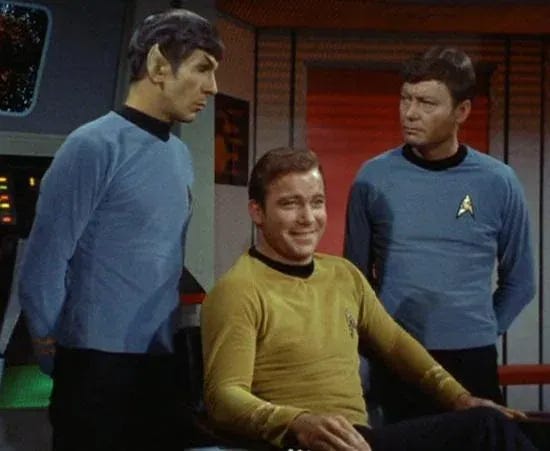
You know what happens if we take Kirk, Spock, and McCoy, and switch their ranks? Make McCoy the captain and watch him get a bit more overbearing. Make Kirk third in command and watch him get less confident. Leave Spock the knowledge man in the middle. You’ve seen this movie as well:
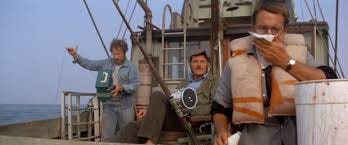
The core character arc in Red State Mars doesn’t belong to any individual. Rather, it is the arc of the Newcastle clan as they try to avoid being early-third-act Brody and realize their potential to be prime timeline Kirk.
Thus I find the character work interesting on multiple levels and give props to the irascible online autist.
If you’d like to support my writing, you can leave a tip at this Stripe link or with Paypal. You can also become a subscriber with the button below.